TAGS

COLLEGAMENTI


JOSE DE GUIMARAES

Biography Summary
José de Guimarães was born on 25 November 1939 in Guimaraes, Portugal. He
studied in Portugal and in various European countries.
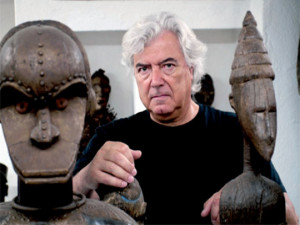
From 1967 to 1974, the artist resided in Angola, immersed in the culture and studying
African ethnography and native art. This is when Guimarães began his fascinating
project of synthesis: creating osmosis between the African and European cultures.
Guimarães’ fascination with other cultures continued to grow. In 1989, the artist
worked closely with the Japanese culture creating various sculptures and public art
pieces for the country. Numerous public works by Guimarães can be found in Tokyo,
Kobe, Akita, Kyoto, Tsunami and Kushiro to name but a few cities. And other works
are also on display in Japanese galleries and museums, including Fuji Television
Gallery, Akemi Foundation, and many others.
Around 1993, the artist travelled extensively to Mexico to explore the archaeology
and the richness of the culture. In 1996, Guimarães completed two
azulejos murals for a metro station in Mexico. His “Mexico” series was exhibited in different
European countries as well as in the Museum of Modern Art in Mexico (1997). The
Mexican National Museum of Grabado organised a retrospective of Guimarães’
drawings.


In 1999, Guimarães inaugurated eight life-size, monumental sculptures – steel trees
with neon lighting for a new “Art Garden” in Macao.
Back in his homeland, “Lisbonne”, a sculpture 26 meters high, was installed in la
Plaça on 25 of April 2001 in the capital. The city’s mayor also organised a
retrospective exhibition, “Cordoaria Nacional”.
In the same year, 2001, another retrospective exhibition was held in the Museum of
Würth, Germany. 2002 saw a selection of the artist’s pieces exhibited at Hillside
Forum of Daikanyama in Tokyo and his contemporary works displayed at the Fuji
Television Gallery. The artist also participated in the international exhibition “Haag
Sculpture 2002” in the Netherlands. The public art piece, Deutsche Oper, was also
created for a metro station in Berlin. In 2003, two retrospective exhibits were
organized: one for the Caixanova cultural centre in Vigo, Ourense and Pontevedra,
Spain and the second for the inauguration of the Forum Würth in Arlesheim,
Switzerland and in 2005 an anthological exhibition was organized in São Paulo,
Brazil.

The international experience continues to add to the richness of the art, and deepened
Guimarães’ creative purpose, to connect different cultures.
His upcoming exhibits include a solo show at the London Art Fair in January 2006 as
well an exhibition of the artist’s works in Beijing during the Spring.
The Gallery Neupergama in Portugal exhibits the series, “The Battle of Carthage”.
His most recent pieces with neon lighting are permanently on display in Paris at
Gallery Hélène Lamarque.
Art Commentary
José de Guimarães was born in Portugal and educated throughout Europe. In the
seventies, he spent seven years in Angola immersed in the study of African
ethnography and art. It is at this point that Guimarães’ fascination with the synthesis,
the osmosis, of different cultures began. And it is at this point he says he became an
artist.
He developed an “alphabet” of symbols. It started in Angola, inspired by the
inscriptions of the “Ngoygos”, the Cabinda tribe, but soon the alphabet became less
ideographical, less tied to a place, and more universal, more automated. The aim was
not to capture a singular idea/object unique to a place, but one that was trans-cultural
yet personal, a metamorphosis of European and African archetypes and ideas. He has
since journeyed to Asia and Mexico, and his alphabet has evolved to incorporate his
experiences and observations from these other places.
The works are thus a combining and a superimposing of symbols, prototypes and
myths. But they are not just anthropological: in their formal and ideological
automatism, they also have philosophical implications. In assimilating,
metamorphosing, Guimarães is interested in the expansion of the Being. As the artist
states, “my creative purpose has a true sense of interconnection among the different
cultures I have deeply observed in order to produce a peaceful and a utopian melting
pot of cultures.” For forty years the artists has created baroque work, exuberant with
complete freedom and spontaneity, trying to capture the range of universal human joy
and tragedy.
In the exhibition at the London Art Fair – Art Space, he presents his most recent
works which use neon lights, in addition to his characteristic combination of
paintings, sculptures, cut objects, boxes and relics. In fact, the use of neon marks a
change in the design and representation of the alphabet. If, during the second half of
the 20th century, the incorporation of the “Fee Electricite” (as in the eponymous
painting by Dufy) appears in plastic art to renovate the work on shade and darkness,
then Guimarães’ ideal is quite different. He chooses neon as a symbol of today’s
urban environment.

He first used neon in a public artwork at the Carnide metro station in Lisbon in 1998,
as a source of light both tangible and malleable. The light creates a new power in the
colour, which emerges like an aura. The light conveys an allegorical meaning: the
medium is spiritual, providing energy to his symbols. At the same time, it also creates
intervals between his recurrent forms. In this way, a new syntax is created to connect
his alphabets.

“Religare” (to connect in Latin) could be the leitmotiv for his works: not only to
connect cultures, but also to connect the archetypes of traditional and modern life.

jose_de_guimaraes